Concrete is one of the most widely used construction materials in the world, and across South Africa it forms part of everything from residential and commercial buildings to industrial structures and infrastructure. It is strong, versatile and durable, but that doesn’t mean it is immune to cracking.
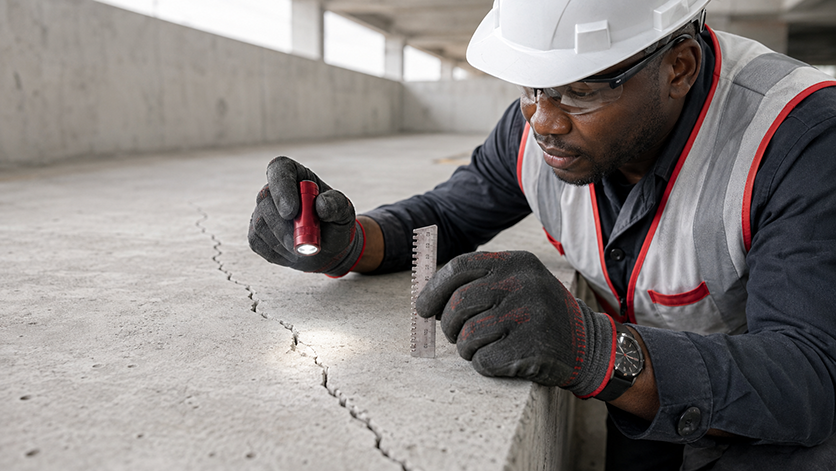
Cracks in concrete are common, but they don’t all mean the same thing. A fine surface crack may have a very different cause and significance from a crack that continues to move, allows water to enter or appears alongside significant concrete deterioration.
This makes one question particularly important when assessing concrete cracks:
Is the crack simply a symptom, or is it telling you something about the condition of the concrete?
The answer begins with understanding why the crack occurred.
Why does concrete crack?
Concrete can crack for many different reasons. Shrinkage, movement, loading, temperature changes, environmental exposure and deterioration can all contribute to cracking.
The cause matters because the repair approach needs to be appropriate to the condition that created the crack in the first place.
A crack that has stopped moving may be treated differently from one that continues to open and close. Likewise, cracking caused by deterioration or reinforcement corrosion may require a much broader concrete repair strategy than a relatively isolated surface crack.
This is why simply filling every visible crack with the same material is rarely an appropriate approach.
Before repairing a crack, understand the crack.
When should a concrete crack be considered a problem?
There isn’t one measurement that can determine whether every concrete crack is serious. Its location, width, depth, movement and cause all need to be considered.
It is also important to look at what is happening around the crack. Is the concrete deteriorating? Is there staining or evidence of water ingress? Is reinforcement exposed? Is the crack becoming wider or extending into other areas?
The type of concrete element matters too. A crack in a non-structural surface may have very different implications from one occurring in a beam, column or other structural element.
For this reason, cracks that appear to be associated with structural movement or deterioration should be assessed by an appropriately qualified professional before repair work is undertaken.
Static cracks and dynamic cracks
One of the most important distinctions when assessing concrete cracking is whether the crack is static or dynamic.
A static crack is one that has stopped moving. Depending on its cause and location, it may be possible to repair or stabilise it using an appropriate repair system.
A dynamic crack, however, continues to move. This creates a different challenge because a rigid repair material may not accommodate the movement. If the underlying movement is not addressed, the crack may simply reappear after the repair.
a.b.e.’s crack repair methodology highlights the importance of establishing the cause of cracking before selecting the repair approach and notes that dynamic cracks need to be assessed in terms of their movement. Where appropriate, the repair may need to accommodate that movement rather than simply filling the crack.
The distinction is important because a crack isn’t the problem you are trying to repair; the condition causing the crack may be.
What about structural cracks?
Some cracks require considerably more investigation than others.
Where a crack appears in a structural component, or where there are signs of significant movement, deterioration or reinforcement corrosion, the priority should be establishing the structural condition of the concrete.
A structural crack should not be treated as a routine maintenance problem simply because it can be filled or covered.
a.b.e.’s concrete repair methodology recommends a structural assessment to establish structural integrity and repairability, followed by a diagnostic assessment to establish the cause and extent of deterioration.
This approach helps ensure that the repair strategy is based on an understanding of the structure rather than the appearance of the crack alone.
Repairing concrete starts with diagnosis
Once the cause and condition of the crack have been established, the repair approach can be considered.
This begins with assessing the crack itself and the surrounding concrete. The repair area may need to be opened, cleaned and prepared so that loose material, dust and contaminants are removed and a sound substrate is available for the repair system.
Preparation is particularly important because a repair material can only perform as intended when it has a suitable surface to bond to.
The repair method then needs to be selected according to the nature of the crack and the condition of the concrete.
There is no single concrete crack repair product that is appropriate for every situation.
Choosing the right repair system
Different types of concrete deterioration require different repair approaches.
For certain crack repair applications, a.b.e. offers epoxy-based crack injection systems designed to penetrate and stabilise suitable cracks. Other situations may require concrete repair mortars for reinstating deteriorated or spalled concrete.
Where the concrete is exposed to water or aggressive environmental conditions, protection may also need to form part of the overall repair strategy.
The important point is that the repair system should follow the diagnosis.
Don’t select the repair first and then try to make the problem fit the product.
Cracks can also become pathways for water
A crack may be more than a visual defect.
Where water can enter through a crack, moisture can contribute to further deterioration and potentially create additional problems within the concrete or surrounding structure.
This is particularly important where concrete forms part of a waterproofing or water-retaining structure.
In these situations, repairing the crack may be only one part of the solution. The wider concrete protection and waterproofing requirements also need to be considered.
This is where a system-based approach becomes important: the objective is not simply to make the crack disappear, but to restore and protect the concrete according to the conditions it will continue to face.

Cracks can also become pathways for water
A crack may be more than a visual defect.
Where water can enter through a crack, moisture can contribute to further deterioration and potentially create additional problems within the concrete or surrounding structure.
This is particularly important where concrete forms part of a waterproofing or water-retaining structure.
In these situations, repairing the crack may be only one part of the solution. The wider concrete protection and waterproofing requirements also need to be considered.
This is where a system-based approach becomes important: the objective is not simply to make the crack disappear, but to restore and protect the concrete according to the conditions it will continue to face.
What if the concrete is already deteriorating?
Cracking can sometimes occur alongside other visible signs of concrete deterioration, including spalling, delamination, exposed reinforcement, corrosion staining, honeycombing or surface breakdown.
When this happens, the problem may extend beyond the crack itself.
The surrounding concrete needs to be assessed to determine the extent of the deterioration and whether reinforcement or other components have been affected.
A repair may therefore involve removing deteriorated concrete, preparing the exposed area, addressing reinforcement where required and reinstating the concrete with an appropriate repair material.
Again, the principle is the same:
- Understand the extent of the problem before deciding how to repair it.
- Don’t just fill the crack
- There is an understandable temptation to repair a visible crack as quickly as possible.
- But concrete repair should be more than making a defect disappear.
- A successful repair needs to consider why the crack occurred, whether it is moving, what condition the surrounding concrete is in and what environmental conditions the repaired area will be exposed to.
The process should therefore be closer to:
Observe. Diagnose. Assess. Specify. Prepare. Repair. Protect.
rather than simply:
See the crack. Fill the crack.
That difference in approach can have a significant impact on the long-term performance of the repair.
When should you get professional advice?
If a concrete crack is growing, appears to be moving, is associated with significant water ingress or occurs alongside spalling, exposed reinforcement or other deterioration, it should be investigated rather than simply covered.
The same applies to cracks appearing in structural elements such as beams, columns or structural slabs.
Where there is uncertainty about the cause or significance of the crack, professional assessment can help determine the appropriate next step.
The goal is not to create unnecessary concern around every crack. It is to make sure that potentially significant defects are not treated as cosmetic problems when they require a more thorough assessment.
Building resilience starts with understanding failure
Concrete repair is ultimately about more than repairing what can be seen.
It is about understanding how and why deterioration occurred, selecting a repair approach that addresses the condition and protecting the concrete against the environment in which it needs to perform.
For a building or infrastructure asset, this can mean moving from reactive maintenance towards a more considered approach to durability and service life.
That philosophy sits at the heart of a.b.e.’s broader role in construction chemicals: helping protect, repair and maintain the built environment through solutions designed for different construction and infrastructure challenges.
Across Africa, where buildings and infrastructure face demanding environmental and operational conditions, building resilience means thinking beyond the immediate repair.
Diagnose correctly. Repair appropriately. Protect for longer.
Helping Africa build to last
A concrete crack may only be a line on a surface, but it can also be an indication of something happening beneath that surface.
The right response begins with understanding the difference.
Because when it comes to concrete repair, the objective isn’t simply to hide the crack.
It’s to understand the failure, address it appropriately and help the concrete perform for longer.