
SHRINKAGE COMPENSATED FLUID MICRO-CONCRETE INCORPORATING MIGRATING CORROSION INHIBITOR (MCI)
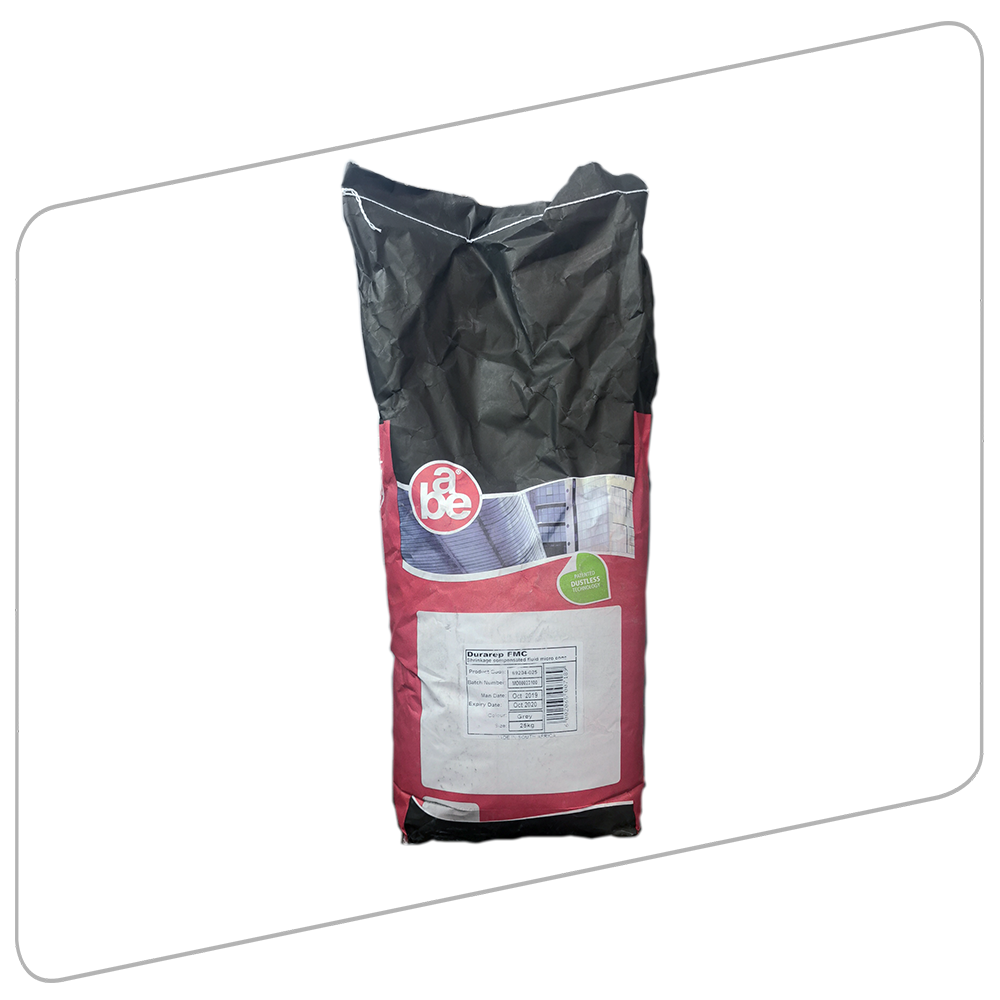
durarep FMC is a cement based, non-shrink, high-strength, fluid micro concrete, which can be applied by pouring or pumping. The select grading of aggregates and special additives ensures that there is no segregation when pouring, that the thermal coefficient of the cured product matches that of the concrete, that the product has improved strength and is less permeable.
The product is supplied in a ready to use form requiring only the addition of a small amount of water for easy mixing to produce a fluid consistency. This can then be applied 50 mm or thicker into suitable shuttered repair areas.
durarep FMC is a Class R4 structural repair mortar according to EN1504-3.
Uses
durarep FMC is particularly used for:
- Reinstatement of large sections of structural concrete with greater than 50 mm thickness
- Can be applied in excess of 250 mm depending on the nature of the repair and the reinforcing
- High fluidity required in restricted or congested reinforcing steel elements where compaction or vibration is not possible
- Shuttered applications for large pours where trowel or hand packed applications are impractical
- Dams, weirs, bridges, buildings and concrete structures in general
- Potable water retaining structures and water cooling towers
Application
- Dual shrinkage control in the plastic and hardened phase
- Exhibits excellent adhesion to concrete substrates without the use of primers
- The high strength and low permeability provides maximum protection against ingress of chloride and carbon dioxide corrosion
- High alkalinity will protect the reinforcing steel against corrosion
- Can be pumped or poured into restricted or congested areas
- Due to its self-compacting properties it eliminates honeycombing, displacing air without vibration
- Ease of application require mixing with the addition of clean water
- Constant quality/performance (pre-blended)
- Chloride free and less dust irritation
- Non-toxic for potable water retaining structures
Typical Physical Properties
| TYPICAL PHYSICAL PROPERTIES | |
| Initial set (20 °C) set @ 20 °C (EN 196-3) | 10 hours |
| Final set (20 °C) (EN 196-3) | 15 hours |
| COMPRESSIVE STRENGTHS – MPA ASTM C109, (40x40x160mm prisms: EN 196-1; EN 12190; EN 1015-11) | |
| 1 day | 16 MPa |
| 3 days | 28 MPa |
| 28 days | >58 MPa |
| Wet expansion (EN 12617-4) | 0,07% |
| Drying shrinkage (EN 12617-4) | 0,07% |
| Wet density (EN 12350-6) | 2 265 kg/m³ |
| Water Addition | 2,7 ℓ per 25 kg |
| Yield | 12 ℓ /25 kg |
| Flow property (EN 13395-2) 975 | 975 mm per 20 sec |
Surface Preparation
The substrate must be sound, firm and clean, free of oil, grease, loose particles and cement laitance, old layers of paint, or other contaminants. Square cut all edges to be repaired to a minimum depth of 10 mm, perpendicular to the surface.
The rest of the repair area must then be broken back to a depth in excess of 50 mm and remove all unsound material. Never feather edge the product. When using compressed air for cleaning the air must be clean and oil free.
Assess the initial adhesion or the effectiveness of the degreasing by means of pull-off tests. Expose all corroded reinforcing steel and grit blast. A bright steel finish is required ensuring that all corrosion products are removed, particularly behind the steel. The typical anchor pattern should be about 40 to 60 microns from peak to valley.
durarep FMC is designed to be cast into and restrained by nonabsorbent formwork that will prevent any loss of material. Allowance must be made for the drainage of water used to saturate the surface.
For easy release the formwork must be treated with durastrip.
Bonding / Priming
Surface saturation is carried out at least four hours prior to placing durarep FMC. This is achieved by filling the prepared formwork with
clean water and draining just prior to placing durarep FMC. It is important that all excess water is drained with no free water remaining.
Use epidermix® 344 wet-to-dry epoxy as a primer for structural applications where the bond strength must be equal or greater than the parent material. All exposed reinforcing bars must be primed by applying durarep ZR primer. (See relevant data sheets). Allow the epoxy to become tacky before applying the repair mortar.
Always ensure that sufficient resources (labour, water, power) are available to provide continuous mix material.
A suitable size mixing vessel that will accommodate full bag lots using a pan mixer for forced action mixing is recommended.
For small batches a heavy duty industrial drill and spiral paddle stirrer that operates around 400 to 500 r/min can be utilised.
In either event tumble type mixers are not permissible. Add approximately 3/4s of the required mixing water and while stirring, slowly add the bag content, and mix for 1 minute until lump free. Add the remainder of the water and mix for 2 to 3 minutes until the mortar is again completely homogeneous and lump free. It is recommended that the mixed durarep FMC be passed through a suitable coarse screen to identify any unmixed material prior to placing or pumping.
Single bag mixes with a drill and paddle require the total water content addition and mixed for 3 minutes. Always add powder to water. The fluid mortar can now be poured into the water tight formwork.
NOTE: High-speed mixing entraps an excessive amount of air and therefore should be avoided.
Mixing
Place approximately 2.0 litres of water in the grout mixer first, then, whilst mixing slowly add the grout and mix for 2 to 3 minutes. Add the balance of the mixing water, 0.7 litres, and mix approximately for 1 minute to obtain the correct consistency ensuring the grout is homogenous and free of lumps. Pour the grout into the pump hopper through a screen with 3 mm openings to separate any lumps and start pumping.
Coverage
25 kg of durarep FMC powder mixed with 2,7 litres of water yields approximately 12 litres.
Application
durarep FMC can be pumped or poured into the formwork provided. This should be done as a continuous operation and must take place within 30 minutes of mixing. Thereafter the product characteristics will change, affecting its fluidity and expansion properties.
The pump and pipeline must be thoroughly lubricated by pumping a rich cement slurry or mortar through the system, which is then discarded and immediately followed by pumping the product. Always pour or pump from one side only to avoid air entrapment.
Cleaning
Clean tools with water before the mortar hardens. Hardened material can only be removed by mechanical means.
Protection on Completion
The formwork should be left in place for at least 24 hours until the compressive strength of the durarep FMC is 10 MPa or higher. durarep FMC should be cured as soon as the formwork is removed. First soak all exposed areas of the repair with clean water. This is followed by applying, by brush or spray, a suitable curing compound like duracure WB or as recommended by a.b.e.®
In rapid drying conditions caused by high winds or direct sunlight additional precautions should be included, like sealing with polythene sheeting. This may include damp hessian behind the sheeting to prevent moisture loss.
In cold conditions, the repaired area must be protected from freezing. For additional protection properties, durarep FMC is fully compatible with the duracote range of protective coatings when chloride and carbon dioxide screening is essential.
Temperature & Relative Humidity
Surface and ambient temperature must be at least 5 °C and rising, ideally between 20 °C and 30 °C.
Packaging
durarep FMC is supplied in 25 kg polyethylene lined paper bags. (Product code: 30798).
Model Specification
A cement based non-shrink concrete reinstatement grout, which can be applied by pouring or pumping.
The micro-concrete will be durarep FMC, a shrinkage compensated, fluid micro-concrete applied in accordance with the recommendations of a.b.e.®, including durarep ZR primer for steel and epidermix® 344 slow-cure wet-to-dry epoxy adhesive where necessary.
durarep FMC is a Class R4 structural repair mortar according to EN1504-3:
| 1 – Determination of compressive strength, EN 12190 | 82,8 N/mm2 |
| 2 – Chloride ion content, EN 1015-17 | <0,01% |
| 3 – Measurement of bond strength by pull-off, EN 1542 | 3,5 MPa |
| 4 – Determination of retraction and expansion, EN 12617-4, Method controlled movements | Shrinkage: 3,4 MPa |
| Expansion: 3,3 MPa | |
| 5 – Freeze-thaw cycling with icing salt immersion, EN 13687-1 | 3,0 MPa |
| 6 – Thermal compatibility: Thunder Shower, EN 13687-2 | 3,1 MPa |
| 7 – Determination of resistance to carbonation, EN 13295 | Dk ≤ reference concrete MC(0,45) |
| 8 – Determination of the module of elasticity in compression, EN 13412 | 31,5 GPa |
| 9 – Determination of resistance of capillary absorption, EN 13057 | 0,03 kg/(m2 x h0,5) |
| 10 – Determination of the coeffient of thermal expansion, EN 1770 | 15,3 μm/m °C) |
| 11 – Skid resistance EN 13036-4 | Dry – 67 |
| Wet – 41 |
Packaging
durarep FMC is supplied in 25 kg polyethylene lined paper bags.
Handling & Storage
This product has a shelf life of 12 months if kept in a dry cool place in the original packaging. In more extreme conditions this period might be shortened.
Important Note
This data sheet is issued as a guide to the use of the product(s) concerned. Whilst a.b.e.® endeavours to ensure that any advice, recommendation, specification or information is accurate and correct, the company cannot accept any liability for application – because a.b.e.® has no direct or continuous control over where and how a.b.e.® products are applied.
Further Information
Where other products are to be used in conjunction with this material, the relevant technical data sheets should be consulted to determine total
requirements.
a.b.e.® has a wealth of technical and practical experience built up over the years in the company’s pursuit of excellence in building and construction
technology.
Please consult our website for our latest datasheets.